Technical Overview of Brushless Motors Used in Flexible Roller Conveyor
- Share
- Issue Time
- Jan 28,2026
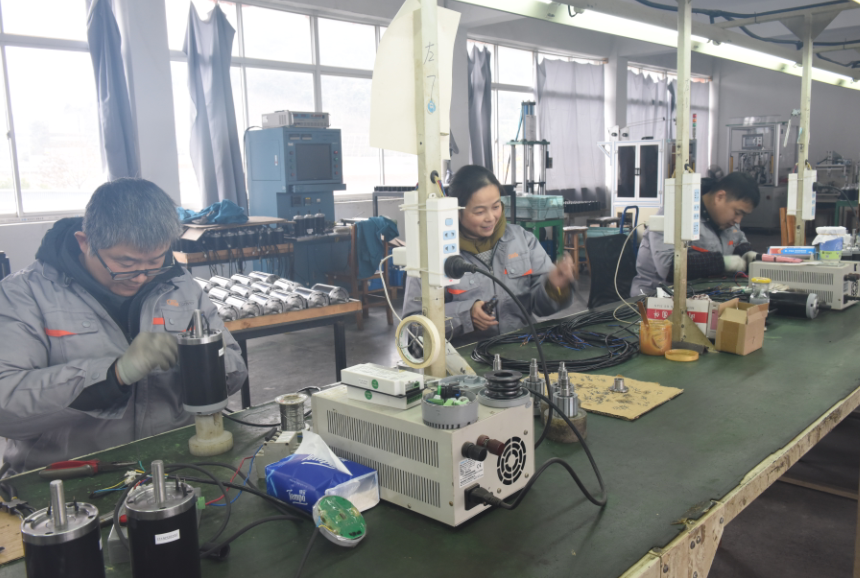
What is a brushless motor?
A brushless motor is an electric motor that operates without carbon brushes or a mechanical commutator.
In a brushed motor, current switching is achieved through physical contact between brushes and the commutator, which causes friction, heat generation, electrical arcing, and wear over time.
In contrast, a brushless motor uses an electronic motor controller to perform commutation by precisely controlling the phase current supplied to the stator windings.
From an engineering perspective, a brushless motor system consists of:
🔹 A permanent-magnet rotor
🔹 A stator with multi-phase windings
🔹 An electronic driver responsible for commutation, speed regulation, and protection functions
This architecture eliminates mechanical commutation and improves system reliability.
What are the technical advantages of brushless motors?
🔹 High efficiency and stable output
Brushless motors achieve higher efficiency by minimizing mechanical and electrical losses. The absence of brush friction and optimized electronic commutation result in stable torque output across a wide speed range, making them suitable for telescopic conveyors operating under varying load conditions.
🔹 Extended service life and reduced maintenance
Since there are no brushes or commutators subject to wear, brushless motors offer a significantly longer service life. This reduces downtime and maintenance costs, which is critical for conveyor systems designed for continuous or high-frequency operation.
🔹 Low noise and low vibration
Electronic commutation enables smoother electromagnetic torque generation. Compared to brushed motors, brushless motors produce lower noise levels and reduced vibration, improving overall system stability and operator comfort.
🔹 Precise speed and torque control
Brushless motors allow accurate control of speed, acceleration, deceleration, and torque through the motor driver. This level of control is particularly important for telescopic conveyors, where smooth extension and retraction, as well as synchronized roller movement, are required.
What power supply configurations are used for our brushless motor systems?
The brushless motors used in Camvey telescopic conveyors are designed to support multiple power supply configurations, ensuring compatibility with different industrial electrical environments.
🔹 Direct DC power input
✔ The motor driver is supplied directly with a DC power source
✔ Suitable for systems with centralized DC power or battery-based installations
🔹 Provides fast dynamic response and simplified power architecture
✔ AC power with conversion to DC
✔ Powered by standard industrial AC supply (e.g. 220V or 380V)
✔ An integrated power conversion and motor control unit converts AC power to DC for the brushless motor
✔ This configuration is widely applicable in factory and warehouse installations
In both configurations, the brushless motor is operated through a dedicated driver that provides closed-loop control, overload protection, and stable operation under varying load and speed conditions.